
LIFESTYLE | JULY 2026 | 5 MIN READ
How a Sicilian in Hannover Speaks the Language of the Set Table — and Why Table Culture Is Never Really About Food
A table can be many things. A surface. A function. A statement. Michele Sortino knows this better than most. Raised between Sicilian hospitality and German interiors, he has worked for years at Lothar John in Hannover — one of the most renowned houses for table culture and luxury living in Germany. Surrounded daily by Christofle, Sieger by Fürstenberg, and Alessi, he has learned that a set table always tells more than what is placed on it. For him, it's not about perfection. It's about attitude.
YOU'RE ITALIAN, LIVING IN GERMANY — TWO CULTURES THAT COULDN'T BE MORE DIFFERENT WHEN IT COMES TO TABLE CULTURE. WHAT HAS THE ITALIAN SIDE TAUGHT YOU ABOUT THE TABLE THAT NO BOOK OR BRAND IN THE WORLD CAN REPLACE?
First and foremost, Italian culture — the culture I come from — didn't necessarily teach me how important a beautifully set or decorated table is. What was conveyed to me was that a table should above all be richly laid and full of food. In Sicily, where my roots lie, food holds a very special place. Cooking, shared meals, and being together at the table are integral parts of the culture. The table is above all a place of encounter, family, and hospitality. But what fascinated me even from a young age was the Italian way of combining beauty and function. Whether in architecture, fashion, art, interior design, or table culture — you can feel everywhere the love of detail and the passion with which things are created. This attitude of giving meaning and value even to the smallest things has profoundly shaped me to this day.
THE ART OF THE TABLE
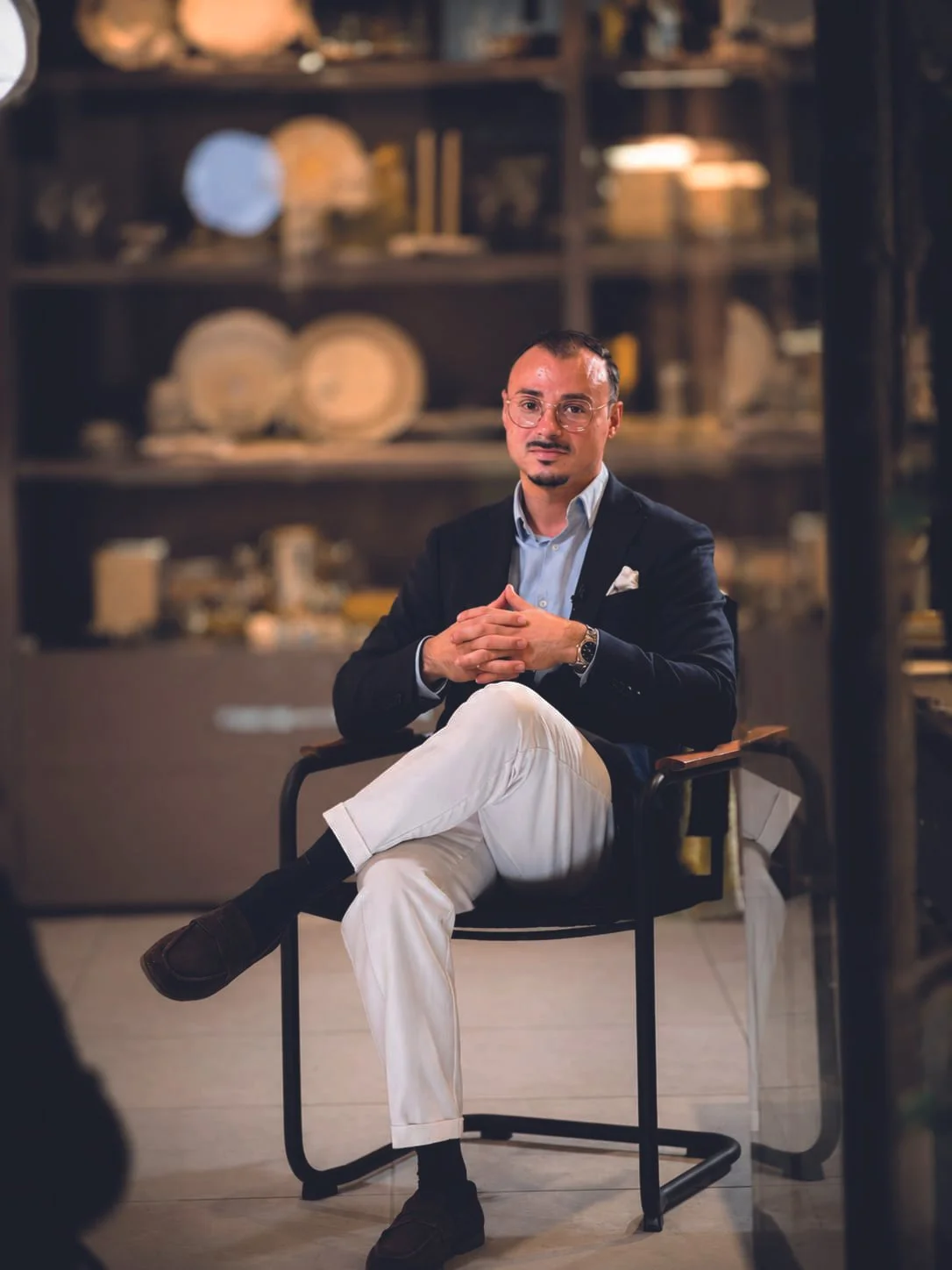
YOU'VE WORKED FOR YEARS AT LOTHAR JOHN — ONE OF HANNOVER'S MOST TRADITION-RICH TABLE CULTURE HOUSES. WHAT CONTINUES TO FASCINATE YOU ABOUT WORKING DAILY WITH OBJECTS THAT ARE MADE FOR EVERYDAY USE, YET CARRY DECADES OR EVEN CENTURIES OF HISTORY WITHIN THEM?
What particularly fascinates me about it is the fact that behind every one of these objects there are people — with ideas, visions, and the courage to create something new. Many of these manufacturers and brands have been inspiring people for decades, some even for centuries. The fact that their designs and values endure to this day and inspire generations of people is something I find truly special. That's precisely why I see it as my task to carry these values, traditions, and stories forward. To keep alive the respect for the craftsmanship, creativity, and passion embedded in these objects — and to give them the appreciation they deserve.
CHRISTOFLE, SIEGER BY FÜRSTENBERG, ALESSI — THREE BRANDS, THREE COMPLETELY DIFFERENT PHILOSOPHIES. IF YOU WERE TO SET A TABLE FOR AN UNFORGETTABLE EVENING, WHICH BRAND GETS WHICH PLACE — AND WHY?
That's actually a difficult question, because I believe every person develops their very own taste throughout life. We identify with design, art, music, history, traditions, cultures, colors, and shapes — and that's precisely why we're drawn to different things. The three brands mentioned stand for completely different philosophies and cultural roots. That's exactly what makes them so fascinating to me. That's why I couldn't decide on just one. If I were to set an unforgettable table, I would rather combine the best of each of these brands: the porcelain from Sieger by Fürstenberg, the silver cutlery and tableware from Christofle, and the iconic design objects from Alessi — such as an espresso maker designed by Richard Sapper or the famous kettle by Michael Graves. For me, true table culture doesn't emerge from choosing a single brand, but from the harmonious combination of craftsmanship, design, tradition, and personality.
LUXURY LIVING AT THE TABLE HAS NOTHING TO DO WITH PRICE — OR DOES IT? WHERE DOES TRUE TABLE CULTURE BEGIN FOR YOU, AND WHAT'S THE DIFFERENCE BETWEEN EXPENSIVE AND TRULY VALUABLE?
Material, quality, and brand have their price — and rightly so. Fair, high-quality products may carry their value. That's exactly where I see the difference between genuine craftsmanship from a manufactory and pure mass production. When we talk about "expensive," many people think first of numbers. For me, however, behind them are people: decades of experience, artisanal skill, creative visions, and often even generations of knowledge passed down over many years. What is truly valuable to me, however, is something different. Valuable are the traditions, the stories, and the moments we experience with our loved ones at a table. True table culture doesn't begin with a price tag, but with appreciation for what stands on the table — and above all for the people who take their places at it.
YOU SHOW ON INSTAGRAM HOW TO NOT ONLY SET A TABLE, BUT TO STAGE IT. WHAT'S THE MOST COMMON MISTAKE PEOPLE MAKE WHEN TRYING TO MAKE THEIR TABLE LOOK BEAUTIFUL — AND WHAT CHANGES EVERYTHING IMMEDIATELY?
Actually, for me there's no right or wrong when it comes to setting a table. Every person has their own taste and a very personal idea of what is beautiful. Some love a minimalist style, others prefer something opulent, classic, colorful, or timelessly elegant. The most common mistake, in my view, is not the choice of a particular style, but when someone tries to combine too many different styles at once. Then a table quickly looks restless and loses its harmony. What immediately changes everything is a clear line. When you decide on a style, a color palette, or a particular atmosphere and carry it through consistently, a cohesive overall image emerges. That's exactly when a set table becomes a staged setting with personality. And that applies not only to table culture, but to interior design as a whole. Rooms, just like tables, tell a story. The clearer that story is recognizable, the more harmonious and inviting the overall picture becomes.