
SPORTS | AUGUST 2026 | 5 MIN READ
POLO IS THE NEW OLD MONEY —
HOW A CENTURIES-OLD SPORT IS BECOMING THE LIFESTYLE CODE OF A NEW GENERATION
Polo was once a world of its own. Wide expanses of perfectly manicured grass, white trousers, leather riding boots, champagne in the clubhouse, and names more likely to appear in society pages than in sports news. A sport defined by rules, traditions, and a certain social distance. And perhaps that is precisely why it feels so interesting that polo is suddenly appearing where you would least expect it: on TikTok, Instagram, and in the feeds of a generation that has created an entire aesthetic around the term “Old Money.” Because polo is no longer just a game played on horseback. It is an image of a life. And images, as we know, are one of the fastest ways to turn a niche into a culture. You only have to look at the setting: sunglasses, linen shirts, riding boots, oversized straw hats, champagne glasses in hand, and somewhere in the background, a perfectly manicured polo field.
Then there is the Divot Stomp, when spectators walk onto the field after the match to press the torn-up pieces of grass back into the ground. It is almost too perfect not to be made for social media. Except this aesthetic wasn't created on social media. It was always there. It has simply been discovered. That is what makes the current polo moment so fascinating. As the term “Old Money” is played with, copied, and reinterpreted millions of times on TikTok, an old social world suddenly finds itself with a digital stage. What once required access, heritage, and genuine proximity to certain social circles can now, at least visually, be reproduced by almost anyone. You don't have to grow up in Gstaad to understand the look. You don't have to have been a member of a polo club for generations to post a picture from the sidelines. And you probably don't even need to know what a chukka is to recognize that the setting works. This is where the interesting shift begins: status is increasingly communicated not exclusively through ownership, but through cultural knowledge.
Knowing certain places, understanding certain sports, recognizing certain rituals, and knowing how to move within their aesthetics sends a different signal than simply wearing an expensive product.
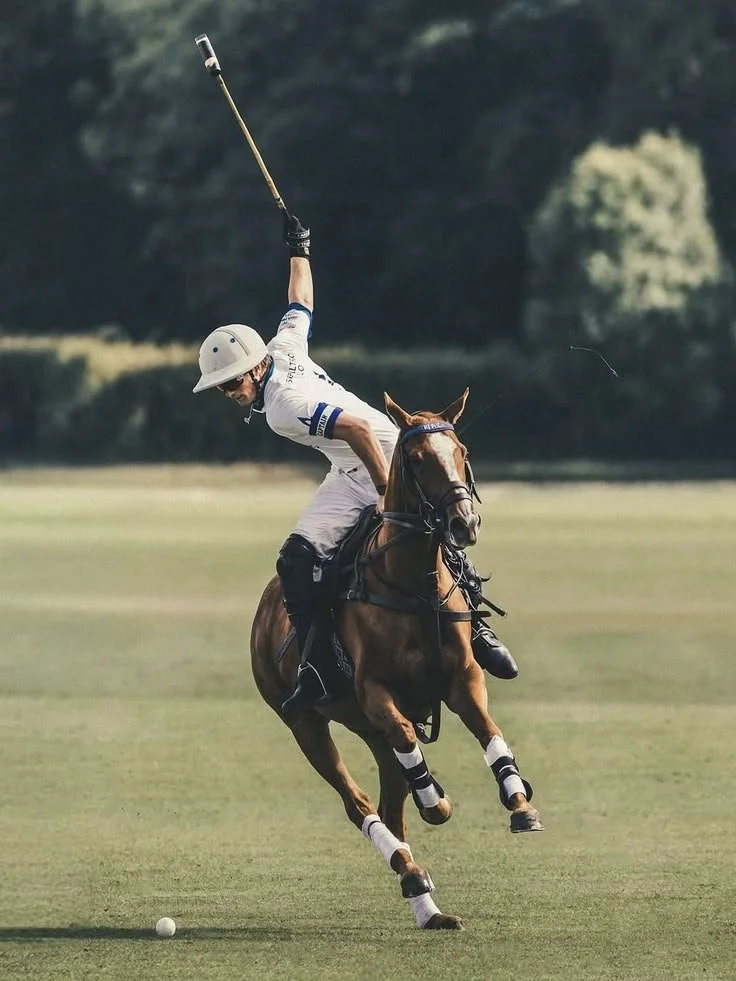
Polo fits perfectly into this new logic. Because unlike a handbag, you can't simply buy a polo moment. It requires time, access, knowledge, and — at least theoretically — a certain degree of proximity to the world itself. That makes it particularly appealing to a generation increasingly drawn to things that don't look like they were created yesterday. Perhaps this also explains why brands such as Hublot and Veuve Clicquot no longer see polo simply as a sport, but as a cultural platform. In Gstaad or Los Angeles, the polo field becomes a stage for luxury, networking, and lifestyle. The sport provides the tradition. The brands provide the present. And somewhere in between, they create exactly what luxury marketing is currently looking for: a world that feels bigger than the product itself.
Prominent polo enthusiasts such as David Beckham and Chris Hemsworth further amplify this new visibility. They don't turn the sport into a mass market. Instead, they give it a modern, accessible surface. Suddenly, polo feels less like a relic of British aristocracy and more like a very contemporary form of leisure culture. The horse remains the defining element. In a world where almost everything is digital, automated, and accelerated, a sport built around an animal, physical presence, and centuries-old rituals possesses an almost unexpected appeal. You can't download a horse. You can't simulate a gallop. And perhaps that is exactly the point. The new fascination with polo is therefore also part of a larger cultural trend: away from the perfect digital surface and toward things that require history, materiality, and real time. Vinyl, mechanical watches, vintage cars, tennis clubs — and now polo. They are all worlds that were not built for maximum efficiency. They demand attention. And that is precisely what makes them so desirable in an increasingly automated world. Of course, there is a certain irony to all of this. “Old Money” has itself become an aesthetic on social media, reproduced millions of times — and in doing so, it democratizes exactly what was originally defined by exclusivity.
Real Old Money, after all, doesn't need to explain on TikTok that it is Old Money. But perhaps that isn't really the point anymore. The generation adopting this aesthetic is less interested in actual heritage than in the feeling behind it: calm instead of noise, tradition instead of trends, quality instead of obvious logos. Polo provides the perfect backdrop for all of it. And perhaps that is the real reason why a sport that spent centuries operating according to its own rules and social codes is suddenly reaching a new generation. Not because this generation suddenly wants to play polo. But because it longs for a world that looks as though it existed long before the algorithm arrived.