
LIFESTYLE | MAY 2025 | 5 MIN READ

HAISTUDIO – LISA AND JONAS
On Community, Movement, and a Space Without a Category
The most meaningful places are often not created from clearly defined concepts — but from a feeling. A longing. That is exactly how haistudio came to life: as a space somewhere between movement, culinary culture, and community — one that deliberately refuses to define itself too strictly.
In a city like Frankfurt, known for speed and structure, the concept almost feels like a counterstatement. Not a traditional studio, not simply an event venue — but a place that evolves alongside the people who use it.
Behind haistudio are Lisa and Jonas — two perspectives that could hardly be more different, and that’s exactly why they work so well together. Somewhere between social media, aesthetics, and entrepreneurial thinking, they created a concept built less on strategy and more on intuition. What stands out most: much of it was never planned — and perhaps that’s precisely why it works.
We spoke with them about how a personal longing became a space that seems to have arrived at exactly the right moment.
A SPACE THAT FEELS LIKE HOME

You describe haistudio as a flexible space between movement, food, and lifestyle. What gap did you see in Frankfurt that made you feel: this city needs a place like this?
Honestly, we didn’t necessarily see a gap — it was more about our own longing. We wanted to create a space where community could emerge and grow. That was really the starting point for us: a dream we simply decided to bring to life. Only afterward did we hear from so many people that something like this didn’t really exist in Frankfurt yet. In cities like Düsseldorf or Cologne, there are already similar concepts. So the timing was almost accidentally perfect. We weren’t consciously searching for a gap — and somehow still found one. And every week we realize more and more that this was exactly what had been missing.
Lisa, as both a creator and entrepreneur, you bring a very distinct perspective on aesthetics and community. What personal experiences or lessons from your social media world guided you while building the studio?
The great thing is, of course, that you already have a community and connections — you’re not starting from zero, and that’s a huge advantage. But one of the biggest lessons for me was realizing how much more valuable real-life interactions are. Social media is amazing for reaching people quickly, but our focus is very clearly on nurturing community offline as well. That’s something we really want to strengthen. At the same time, it’s beautiful collaborating with partners like MV Gallery or local cafés and restaurants. It allows you to think bigger because everyone brings their own community into the space.
Jonas, you come from a very different professional background than Lisa. How has your perspective shaped the strategic direction of the studio — and where do you complement each other most?
It’s actually really interesting because I originally studied education, but I also come from an entrepreneurial family with roots in industry and real estate. That combination helped us enormously. We bring together two completely different perspectives — not only in business, but also in how we approach the space itself and the way we think overall. I naturally look at things less from a social media or marketing perspective and more through the lens of my background. But that contrast complements each other incredibly well. We approach topics like partnerships or the use of the studio very differently — and that difference is exactly where our strength lies.

Your programming is intentionally dynamic: Pilates, dinner events, brand collaborations, pop-ups. How do you decide which formats or partners truly fit into the world of haistudio?
Our core formats are mainly pop-up stores and short-term events. The space is very multifunctional, so those concepts work especially well. What matters most to us is that everything aligns with our vision. For example, we do fewer large parties or classic club formats — even though we’ve experimented with that occasionally. We pay close attention to what fits the neighborhood, the district, and the environment in general — and what feels authentic to us personally. But the most important factor is always the human connection. There have already been partners who wanted to return, but we realized the chemistry simply wasn’t right. That was a big learning for us: we don’t make decisions based on money, but on vision, values, and personality.
Of course, that makes some things more complicated. But long term, we believe it leads to greater success.
Many studios focus either on fitness or on community. You combine both. What role do wellbeing — mentally, aesthetically, socially — play in your overall concept?
A huge one. Our vision is almost like an extended living room. A place where people come together — people you might not necessarily invite into your private home — and still feel completely comfortable. A space where you can arrive, slow down, and simply exist without comparison or pressure.
All three aspects — mental, aesthetic, and social wellbeing — are central to us. It’s also important to us that the space can offer more than one thing. For example, we also host a youth group here, and especially in a city like Frankfurt, we see how important spaces like this are. Places that offer alternatives, where community forms and people genuinely look out for one another.
What we love most is that the studio can’t really be placed into a single category. It’s multifunctional, constantly evolving — from movement and community to dinners and events. That’s what makes it feel alive to us.
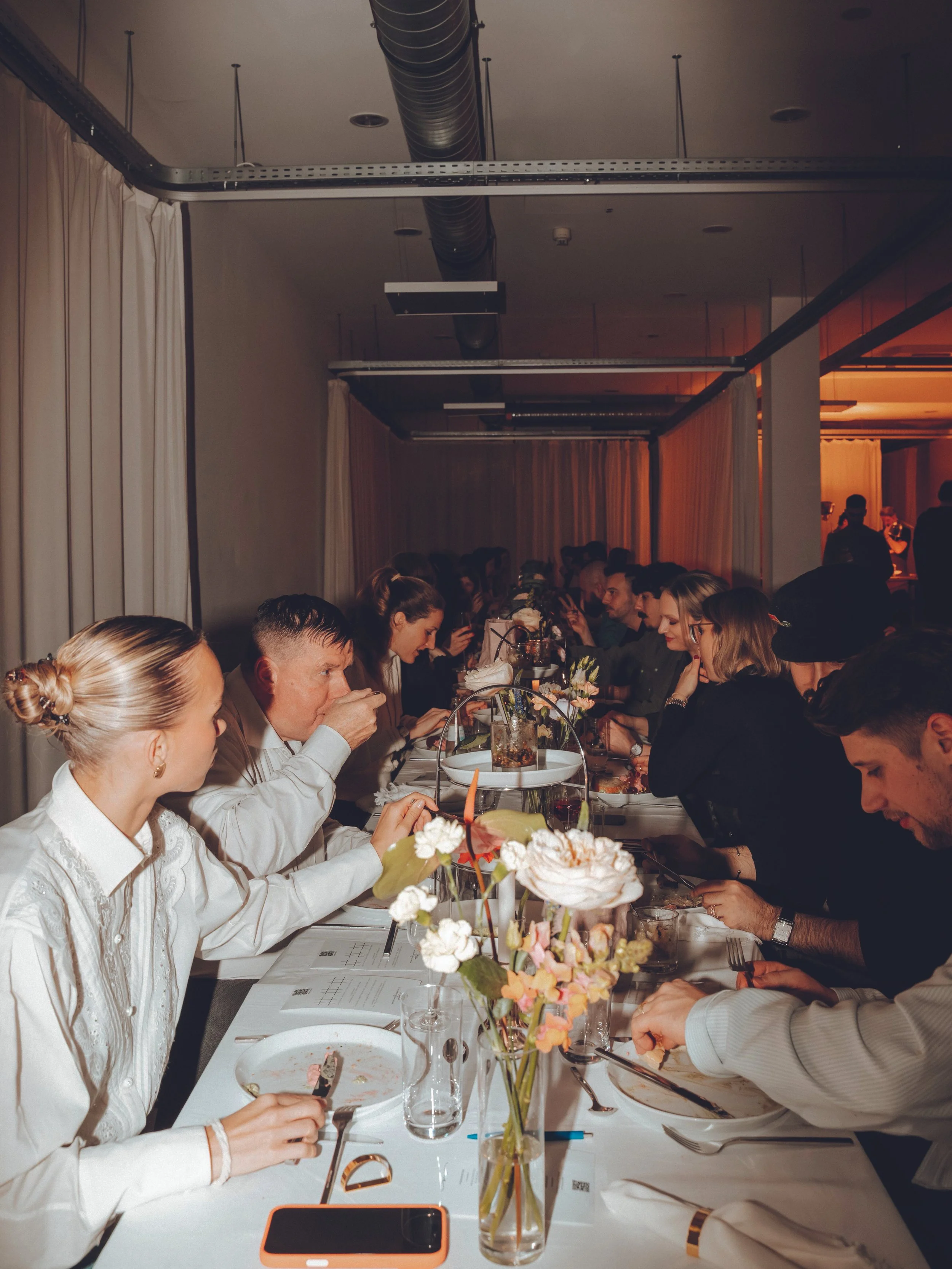
The space itself feels highly curated: the lighting, materials, forms. Which design elements or architectural decisions were essential for you?
For us, having a clean, minimal space was extremely important. White curtains, an open layout, flexible possibilities — a place you can continuously reinterpret. The ceiling and the entire atmosphere of the studio were also essential. What’s fascinating is that when we look at our original vision board today, this space is almost identical to it. Same flooring, same curtains, so much natural light, huge windows — even the air conditioning we had dreamed about.
When we first saw the space, we could hardly believe it. Everything was already there. Plus a kitchen. Plus the location. We had actually expected major renovation costs, but somehow everything simply aligned. Even the location surprised us because we hadn’t fully realized how good it was beforehand. In the end, it felt like pure luck. A little bit of naivety, a little bit of trust — and suddenly everything fit.
When you think about the people visiting haistudio every day, what would be the clearest sign to you that your concept is truly working?
Right at the entrance, we have a small sign that says: You look good.
And that’s exactly what it’s about. Whether someone comes for an event, a dinner, a pop-up, or a session — we want every person to feel seen and accepted. No matter where they come from or what they do. If people don’t just look good here, but actually feel good — and if genuine connection happens — then the concept works. Then we’ve achieved exactly what we wanted: a place that brings people together.
You’ve built a creative business together. What quality do you admire most in each other when it comes to turning vision into reality?
Lisa:
What I love about Jonas is that he connects vision with reality. He’s visionary, but also incredibly solution-oriented. To me, he brings structure and calmness into everything. He also handles so much on-site — especially because we have a family, that’s something I deeply appreciate. He balances out many of my weaknesses.
Jonas:
What I admire most about Lisa is that she sees things before they even exist. I’m also visionary, but often very realistic — I need to see things to fully grasp them. Lisa expands my perspective enormously and introduces ideas I probably never would have pursued on my own.
Many things I initially thought would never work are reality today.
And now we’re sitting here — in this space — talking about it.