
Sport | MAY 2025 | 5 MIN READ
Gucci Racing — When Fashion Takes Its Place on the Grid
Starting in 2027, Alpine will officially become the Gucci Racing Alpine Formula One Team. The first time in Formula 1 history that a luxury fashion house takes its place on the starting grid as a title partner. What that means — and why this moment is bigger than a sponsorship deal. There are announcements you see coming. And then there are announcements that feel like someone pushed together two worlds that were never supposed to touch — and suddenly, it makes perfect sense.
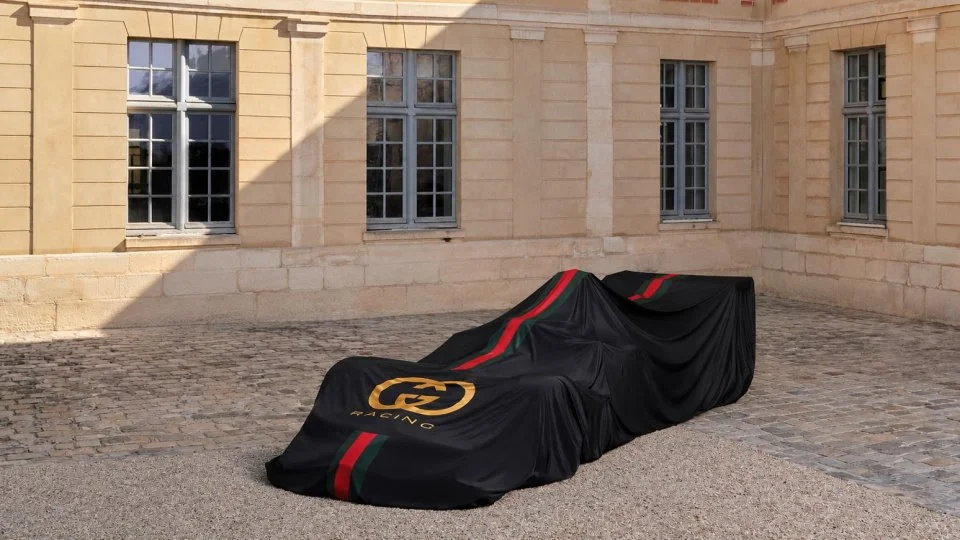
Gucci Racing Alpine Formula One Team. Say it out loud. Let it sink in. This is not sponsorship. It’s a statement. From the 2027 season onward, the Alpine F1 Team will officially race under that name. Gucci’s iconic green-and-red stripe on a Formula 1 car. Flavio Briatore on one side. Gucci CEO Francesca Bellettini on the other. And in between: a deal that pushes Formula 1 one step further from sport into culture — from racetrack to runway.
This Was Only a Matter of Time
Anyone who has watched the evolution of Formula 1 over the last few years knows this partnership was inevitable. Not necessarily this exact deal — but the logic behind it. Formula 1 is no longer just a motorsport series. It has become a global premium-content universe. Monaco, Singapore, Las Vegas — places that already carry an aura simply by existing. Paddock Club. VIP hospitality. Cameras that no longer focus only on the race, but on the people watching it. The overlap between speed and society, precision and prestige. Louis Vuitton is already Formula 1’s official trophy partner. Mastercard became title partner of McLaren for the 2026 season. The luxury world had already begun claiming its place on the grid. Gucci has now taken the next — and loudest — step. And notably, with Alpine. A team that was fighting at the back of the field in 2025 and now sits fifth in the Constructors’ Championship in 2026. A team on the rise. A brand redefining who it wants to be.
The combination works not despite the history — but because of it.
What Gucci Racing Actually Means
This is the key point: this is not simply a logo on a car. Gucci has created an entirely new platform specifically for this partnership — Gucci Racing. Described as a new business and experiential universe built around the values of performance, precision, discipline, and excellence at the intersection of luxury and sport. That is the language of a house that understands what Formula 1 is really selling right now: not lap times. Access. A worldview. An invitation into something that can never be fully explained. Luca de Meo, CEO of Kering and the man who once transformed Renault Sport into the Alpine brand, is the central figure behind this deal. His perspective is precise: Formula 1 now reaches more than 1.5 billion people per season. It attracts a younger and increasingly female audience. It has become a creative space — for technology, culture, and identity. For a luxury brand that cannot buy desirability but must earn it, this is a platform with a reach no campaign budget could ever replicate. This is not sponsorship. This is strategic positioning at a cultural center of gravity.
What Changes on the Grid
From 2027 onward, Alpine will race in Gucci colors. The familiar blue-and-pink livery of the BWT era — arguably the most recognizable design on the grid since 2022 — will disappear. In its place comes the Florentine house’s unmistakable green and red. A color language instantly recognizable anywhere in the world. No explanation needed. And this is where it becomes interesting from a fashion perspective: Gucci is a brand that has spent the past few years redefining itself. Somewhere between the maximalist legacy of the Alessandro Michele era and the more refined, reduced approach under Sabato De Sarno, the house is searching for its next identity. Loud. Bold. Impossible to ignore. A Formula 1 car is the loudest canvas in the world. It travels at 300 km/h. It is seen across 24 time zones. It sits next to yachts in Monaco and skylines in Singapore. It is the only advertising medium that does not become an image — it becomes an event.
The Bigger Question
What this moment really raises is a question the entire luxury industry is currently facing: what happens to a brand when it opens itself to the masses — even through speed and glamour? Gucci is not Swatch. The partnership with Alpine is not about making the product more accessible — the price tags remain exactly where they are. But visibility changes everything. The logo once confined to handbags and belts will now be attached to something flying through corners at 300 km/h. Billions of people will see it. It will exist inside content formats that are twenty years old — and formats that don’t even exist yet. The question is not whether Gucci becomes too visible because of this. The question is whether Gucci Racing can take the house exactly where it wants to be in 2027 — at the forefront of cultural relevance. Not despite Formula 1, but through it. Briatore put it this way: this is more than a presence on the grid. It is an expression of who we are and where we want to take the brand. That is the language of someone who understands the difference between sponsorship and a statement.
What Begins Now
Throughout Formula 1 history, there have always been moments when what happened around the track overshadowed what happened on it. Moments when a deal meant more than money — when it meant meaning. Gucci Racing Alpine is one of those moments. Not because a fashion house is buying into a racing team. But because two worlds — one obsessed with speed, the other with aesthetics — have decided they speak the same language. And because the intersection of those two languages creates something neither could say alone.
We still don’t know what the car will look like.
But it’s hard to wait to see it.